

ACG World: Full site migration with +41% in clicks without losing a single ranking

ACG is an international pharmaceutical equipment company operating across 100+ countries. When their website structure started holding back their organic growth, we redesigned their entire site architecture: new URLs, new navigation, new product pages- without dropping their hard-earned rankings.
ACG's website had grown organically over the years, but the structure hadn't kept up. Their product offerings , spanning capsules, tablet coating, cartoning, packaging films, and more, had no dedicated pages. Visitors who wanted to learn about a specific product category had to submit an inquiry form just to get basic information.
From an SEO perspective, this was a significant missed opportunity. Without dedicated, crawlable product pages, Google had nothing to rank. The site architecture was flat, URLs were inconsistent, and there was no logical hierarchy connecting their product lines.
The problem
The core challenge
Restructure an established international website, changing URLs, navigation, and page hierarchy, without triggering ranking drops or losing the domain authority built over the years.
What we changed
URL structure
Cleaned up messy, archive-based URLs into concise, semantic paths that reflect product hierarchy.
Example: /archives/engineering/secondary-packaging302301 → /cartoning
Example: /archives/engineering/tableting302301 → /tablet_compression
Site hierarchy
Built proper product-page depth so categories no longer dead-end.
Created full sub-hierarchies to enable intuitive navigation for users and clearer signals for search engines.
Example: Before the user journey was /everything_capsules → /capsules
Now: /capsules → /capsules/vegetarian → /capsules/vegetarian/acgcapstm-h
Migration process
Executed a structured, checklist-driven migration in three phases:
Pre-launch UAT checks
Complete URL mapping
Updated sitemaps and robots.txt
Screaming Frog backup of site crawl and more.
Go-live day monitoring
Verified redirects and removed noindex where appropriate
Confirmed analytics tracking and performed mobile checks
Post-migration monitoring (first 15 days)
Tracked 404s and crawl errors
Monitored organic traffic for anomalies
The one hiccup, and how we caught it
GTM tags weren't firing for 2–3 days post-launch, so analytics data wasn't being collected properly. We caught it quickly, resolved the configuration issue, and restored full tracking; there was no data loss affecting the final results.
The Results
+76%
Impressions growth (96K → 169K)
2x
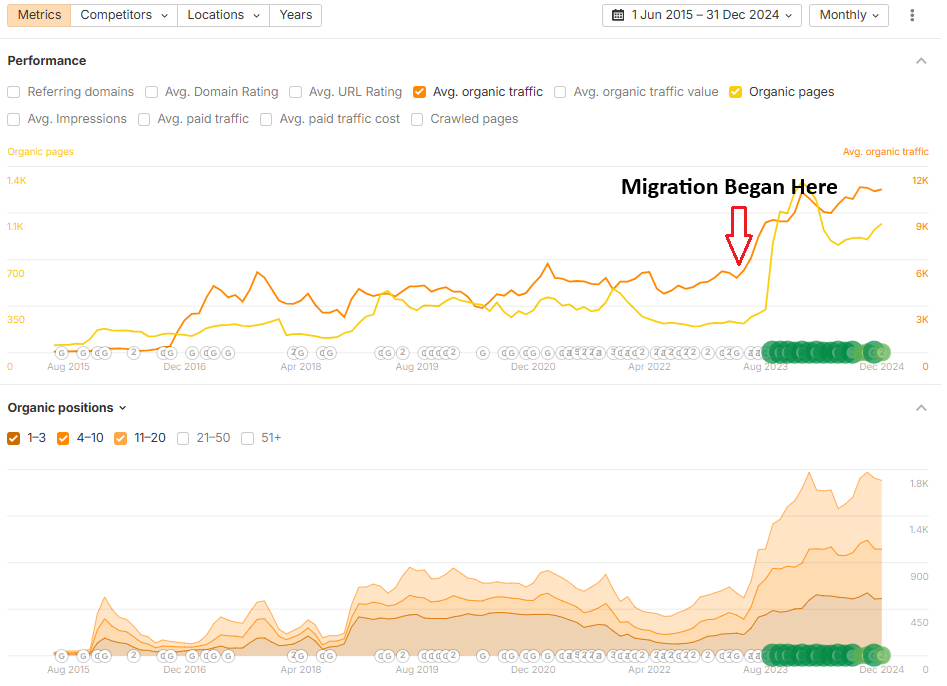
Organic pages indexed post-migration
12K
Peak avg. organic traffic (up from ~6K)
+41%
Total clicks growth (Apr '23 → May '24)
The chart tells the story clearly: flat organic traffic for years, then a sharp inflection point at migration launch in August 2023, followed by sustained growth into 2024. Organic positions in the top 1–20 range also grew significantly across the same period.
The takeaway
Site migrations are high-stakes. Done without a proper process, they can wipe out years of SEO equity overnight. This project showed that with the right preparation — thorough URL mapping, redirect chains, pre- and post-launch monitoring — you can completely restructure a site and come out stronger on the other side.